


Chemical Peel Aftercare: A Clear Guide
What if the best thing you can do after a chemical peel is simplify your skincare routine? It’s understandable to feel unsure when your skin looks red, tight or sensitive, or begins to peel. Knowing what to do after a chemical peel can help you care for your skin calmly, without adding products or steps that may irritate it.
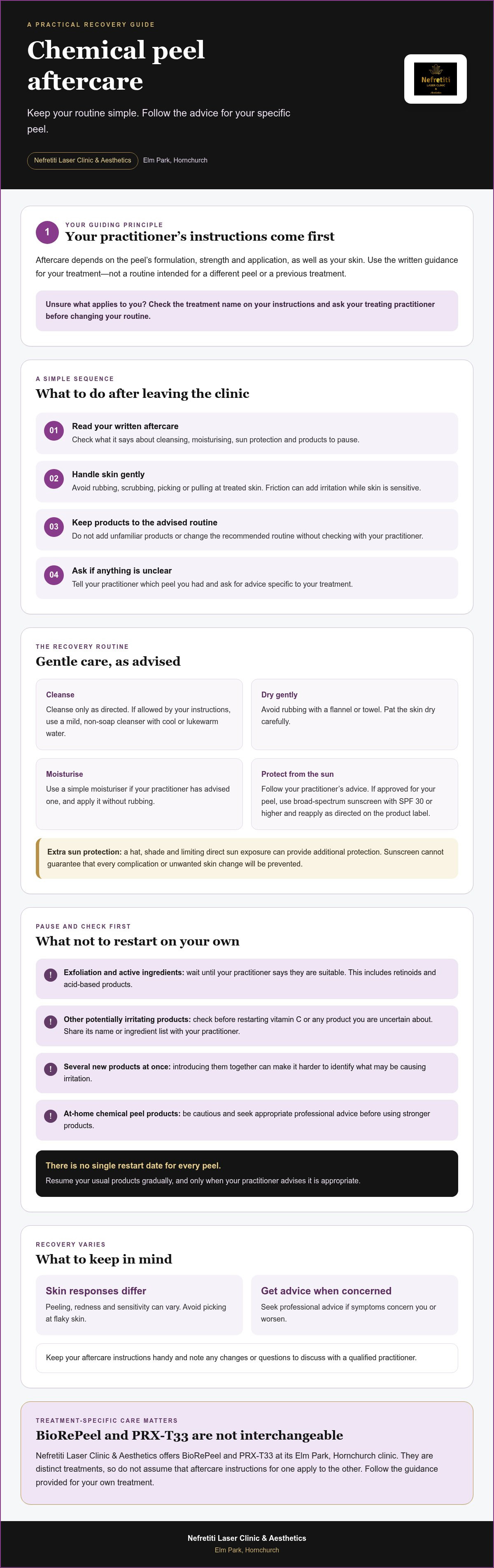
Aftercare depends on the peel and your skin, so follow your practitioner’s personalised instructions first. In general, gentle cleansing, simple moisturising and daily broad-spectrum sun protection can support your skin while it recovers. Avoid picking or pulling at flaky skin, and pause potentially irritating products until your practitioner advises that it’s appropriate to restart them.
This guide covers a practical aftercare routine, products and activities to check before resuming, what peeling and sensitivity may look like, and when to seek advice. Nefretiti Laser Clinic & Aesthetics offers chemical peels, including BioRePeel and PRX-T33, at its clinic in Elm Park, Hornchurch. If you’re considering a peel or have questions about recovery, treatment-specific advice can help you feel more confident about each step.
Table of Contents
What to do after a chemical peel in the first hours
It’s natural to want a clear routine straight away, but aftercare depends on the peel’s formulation, strength and application, as well as your practitioner’s instructions. If you’re wondering what to do after a chemical peel, begin with the guidance for your treatment instead of following a routine intended for a different peel.
Your first steps after leaving the clinic
In the first hours, keep things simple and handle the treated skin gently:
Read your written aftercare instructions. Check what they say about cleansing, moisturising, sun protection and products to pause.
Avoid unnecessary contact. Don’t rub, scrub, pick or pull at the skin. Friction can add irritation while it’s sensitive.
Don’t introduce extra products. Before applying something that isn’t mentioned in your instructions or changing the advised routine, ask your treating clinic.
Contact your practitioner if anything is unclear. Explain which peel you had and ask for advice specific to your treatment.
Your treating practitioner’s instructions take priority over general aftercare advice. That includes advice you find online or instructions you received after a previous peel.
Why peel-specific aftercare matters
Chemical peels use different formulations and may work at different depths, so appropriate care and recovery can vary. A general overview of chemical peel types and procedures can provide background, but it shouldn’t replace your practitioner’s directions for your treatment.
Nefretiti Aesthetics offers BioRePeel and PRX-T33 at its Elm Park, Hornchurch clinic. These are distinct treatments, not interchangeable aftercare protocols. Don’t assume that instructions for one apply to the other, or follow a fixed recovery schedule from a general article. Check the treatment name on your written instructions and ask your practitioner if you’re unsure which advice applies.
How to care for your skin after a chemical peel
A calm, simple routine can make aftercare easier to manage. The right products and when to use them depend on your peel, so use only what your treatment-specific instructions allow. If you’re unsure what to do after a chemical peel, check with your practitioner before changing your routine or adding a product.
Choosing a gentle post-peel skincare routine
Keep care gentle and follow personalised advice. Cleanse only as directed, using a mild, non-soap cleanser and cool or lukewarm water if your instructions allow. Avoid rubbing with a flannel or towel. Pat the skin dry carefully instead.
Use a simple moisturiser if your practitioner has advised one, and apply it without rubbing. Introducing several unfamiliar products at once can make it harder to identify what may be causing irritation. Don’t restart exfoliants or active skincare ingredients, such as retinoids or acid-based products, until your practitioner says they’re suitable. There’s no single restart date for every peel.
Be cautious with chemical peel products used at home. The US Food and Drug Administration describes the dangers of at-home peels. This is US guidance, but it underlines why stronger products shouldn’t be used without appropriate professional advice.
Sun protection after a chemical peel
Skin may be more sensitive to sunlight after treatment. Follow your practitioner’s advice on sun protection, including when to apply sunscreen. If approved for your peel, use a broad-spectrum sunscreen with SPF 30 or higher, and reapply as directed on the product label, particularly after sweating or getting wet. A hat, shade and limiting direct sun exposure can provide additional protection.
Sunscreen is an important part of aftercare, but it can’t guarantee that every complication or unwanted skin change will be prevented. Ask your practitioner what protection is appropriate for your treatment and circumstances.
Returning to your usual skincare
Resume your regular products gradually, and only when your practitioner advises it. Check before restarting exfoliation, retinoids, vitamin C or other products that may irritate sensitive skin. If you’re uncertain about an ingredient, share the product name or ingredient list with your practitioner rather than testing it on treated skin.
For personalised guidance about a chemical peel at Nefretiti Aesthetics in Elm Park, Hornchurch, you can contact the clinic with your aftercare question.
What to avoid after a chemical peel, and what depends on your peel
Aftercare isn’t a universal checklist. Some precautions are sensible for delicate, recently treated skin, but advice about products and daily activities depends on the peel and how your skin responds. Use your practitioner’s instructions to guide each choice rather than applying a fixed timetable from a general article.
Products and habits that may irritate treated skin
Flakes can be tempting to lift, but leave them alone. Pulling at peeling skin or scabs may increase irritation and interfere with recovery. Avoid scrubs and other exfoliation unless your practitioner has specifically advised that they’re appropriate.
Check before using active skincare products, even if they’re familiar parts of your routine. The post-peel care guidance in clinical literature describes the importance of appropriate aftercare, but general information can’t determine what’s right for your individual peel. If a product stings or causes a concerning reaction, stop using it and ask your treating practitioner for advice.
When can you return to your usual activities?
Exercise, hot environments, swimming and make-up are common questions, but there isn’t one safe waiting period for every peel. Your practitioner can advise whether an activity is suitable based on the treatment you received and your skin’s condition. If your skin remains uncomfortable or visibly irritated, check before resuming anything involving heat, sweat, water, pressure or friction.
Make-up guidance can also depend on how your skin is recovering and which products you use. Ask before applying it to treated skin, particularly if removing it might involve rubbing. If your written advice doesn’t cover a planned activity, contact your practitioner rather than guessing. Personalised guidance helps you avoid treating a precaution for one peel as a rule for all peels.
Chemical peel recovery: what may be normal and when to seek advice
Skin can respond differently after a peel. Redness, dryness, tightness, sensitivity or peeling may occur, but these effects aren’t universal and their significance depends on the peel and your individual response. A symptom list can’t diagnose a complication. Follow your treatment-specific instructions and ask your practitioner if you’re unsure what to expect.
Peeling, redness, dryness or sensitivity: what should you do?
Continue with your aftercare plan and avoid rubbing, picking or trying to speed up peeling. Notice whether your skin is settling or becoming more uncomfortable. Another person’s recovery isn’t a reliable guide to yours.
If symptoms worsen, feel more severe than your practitioner said to expect, or concern you, contact the practitioner who performed your peel. Explain when the symptoms began and how they’ve changed. If something doesn’t feel right, ask for personalised advice rather than trying to assess the cause yourself.
When to contact your practitioner or seek urgent help
Contact your treating practitioner about concerning or worsening changes. They can advise whether you need an in-person assessment or further medical advice. This section can’t determine the cause of a reaction, so don’t rely on a symptom list to rule out a problem.
For a severe or life-threatening emergency, follow NHS guidance on when to call 999. If you’re unsure how urgently you need help, use NHS 111 for advice. These services can direct you to appropriate care, but they don’t replace contacting your treating practitioner about peel-specific concerns.
If a change concerns you, contact your treating practitioner rather than waiting for it to settle. Tell them which peel you had, when it was carried out and what has changed. Avoid starting products or trying to treat a concerning reaction without professional guidance.
Plan your next steps after a chemical peel in Hornchurch
A few simple steps can make aftercare easier to follow and help you explain any concerns clearly. Keep your written instructions somewhere easy to find, note the name of the peel you received, and follow the advice for your treatment. If you’re unsure what to do after a chemical peel, ask the practitioner who carried it out rather than relying on instructions intended for a different treatment.
Questions to ask before or after your peel
It’s reasonable to ask for clear, practical guidance. Before treatment, discuss suitability, what the peel involves and how follow-up advice will be provided. Afterwards, check that you know which instructions apply to you and who to contact if you’re concerned about your skin.
Which peel did I have? Ask for the treatment name and make sure it matches your aftercare information.
Which instructions should I follow? Confirm how to care for your skin and what to do if the advice seems unclear.
When can I restart my usual skincare or activities? Ask about your own products, exercise, swimming, heat exposure and make-up rather than assuming there’s a standard timetable.
Who should I contact if I’m concerned? Save the clinic’s contact details and ask what to do if you can’t reach your treating practitioner.
If you notice a change that worries you, record when it began and whether it’s improving or worsening. You may find it useful to take a photograph in consistent lighting to describe the change to your practitioner. This isn’t a substitute for professional assessment. Seek prompt advice if symptoms are getting worse or feel concerning.
Finding personalised chemical peel guidance locally
Nefretiti Aesthetics offers chemical peels, including BioRePeel and PRX-T33, at its clinic in Elm Park, Hornchurch. A personalised discussion can help you explore whether a peel may be suitable for your skin and clarify questions about preparation, aftercare and follow-up. Treatment suitability and advice depend on your individual circumstances. The clinic offers a free initial consultation and requires a patch test for every treatment.
For information about the clinic’s services, see its chemical peel and aesthetic treatment information. The clinic is in Elm Park, Hornchurch, and may be relevant to people seeking aesthetic treatments from Hornchurch, Elm Park, Romford, Upminster, Rainham, Dagenham, Gidea Park, Harold Wood, Harold Hill and across Essex. If you’re considering a peel, you can book a consultation to discuss suitability. Bring details of your current skincare products and any questions so the conversation can focus on guidance relevant to your needs.
Feel confident about your next steps
Good aftercare starts with your practitioner’s instructions, because recovery and product guidance depend on the peel you’ve had. If you’re unsure what to do after a chemical peel, keep your routine simple, avoid picking or rubbing treated skin, and check before restarting active skincare or usual activities.
Some redness, dryness, sensitivity or peeling may occur, but reactions vary. If symptoms worsen or concern you, contact your treating practitioner for personalised advice rather than trying to diagnose the cause yourself.
Nefretiti Aesthetics, based in Elm Park, Hornchurch, offers chemical peels including BioRePeel Skin and PRX-T33. A consultation is an opportunity to discuss suitability, your questions and the aftercare relevant to your treatment, without assuming every peel follows the same routine.
With clear guidance and a gentle approach, you can feel more assured as your skin recovers.
Frequently Asked Questions
What should I put on my face after a chemical peel?
Use only the products approved in your peel-specific aftercare instructions. Your practitioner may advise gentle cleansing, a simple moisturiser and broad-spectrum sunscreen, but suitable products and when to apply them depend on your treatment. Avoid adding unfamiliar products or restarting exfoliants and active skincare until you’ve checked. If you’re unsure what to do after a chemical peel, ask the practitioner who performed it for guidance tailored to your skin.
Can I wash my face after a chemical peel?
Follow the washing instructions for your particular peel, as timing and methods can differ. If washing is permitted, use the approach your practitioner recommends, handle your skin gently and avoid scrubbing or rubbing with a flannel or towel. Pat dry rather than rubbing. If your instructions don’t say when or how to wash your face, contact the treating clinic before cleansing rather than guessing.
How long does it take to recover from a chemical peel?
Recovery time varies according to the peel, its depth and your individual skin response, so there isn’t one reliable timeframe for everyone. Your practitioner should explain what to expect from your treatment and when to arrange any follow-up. Follow the aftercare guidance rather than comparing your progress with someone else’s. If symptoms worsen, persist beyond the expectations you were given or concern you, seek advice from your practitioner.
Is peeling normal after a chemical peel?
Some people may experience peeling or flaking, but it isn’t universal and can vary with the peel and individual response. Don’t pull, pick or scrub loose skin, as this may irritate the area and interfere with recovery. Continue with your personalised aftercare. If peeling is accompanied by worsening discomfort, swelling, blistering or another change that concerns you, contact your treating practitioner for an assessment rather than trying to diagnose it yourself.
Can I wear make-up after a chemical peel?
Ask your practitioner when make-up is appropriate for your treatment and how your skin is responding. There isn’t a single waiting period that applies to every peel. Applying or removing make-up may involve touching or rubbing sensitive skin, so wait until your instructions say it’s suitable. If you’re uncertain, check with the treating clinic and follow its advice about products and gentle removal.
When should I contact a practitioner after a chemical peel?
Contact your treating practitioner if symptoms worsen, feel more severe than expected or concern you. Increasing redness or swelling, significant pain, blistering, broken skin or fluid from the treated area merit professional advice. Seek urgent medical guidance if you also feel unwell or have a severe reaction. For people in Elm Park or Hornchurch, Nefretiti Aesthetics can answer questions about its peel treatments and aftercare instructions.


Comments