


How Many Microneedling Sessions Do You Need for Results?
What if the most useful answer to “how many microneedling sessions for results” isn’t one fixed number? Online estimates can sound definite, especially when you’re planning around recovery and deciding whether treatment suits your skin. In practice, the number of sessions depends on your goals, the concern being addressed and how your skin responds.
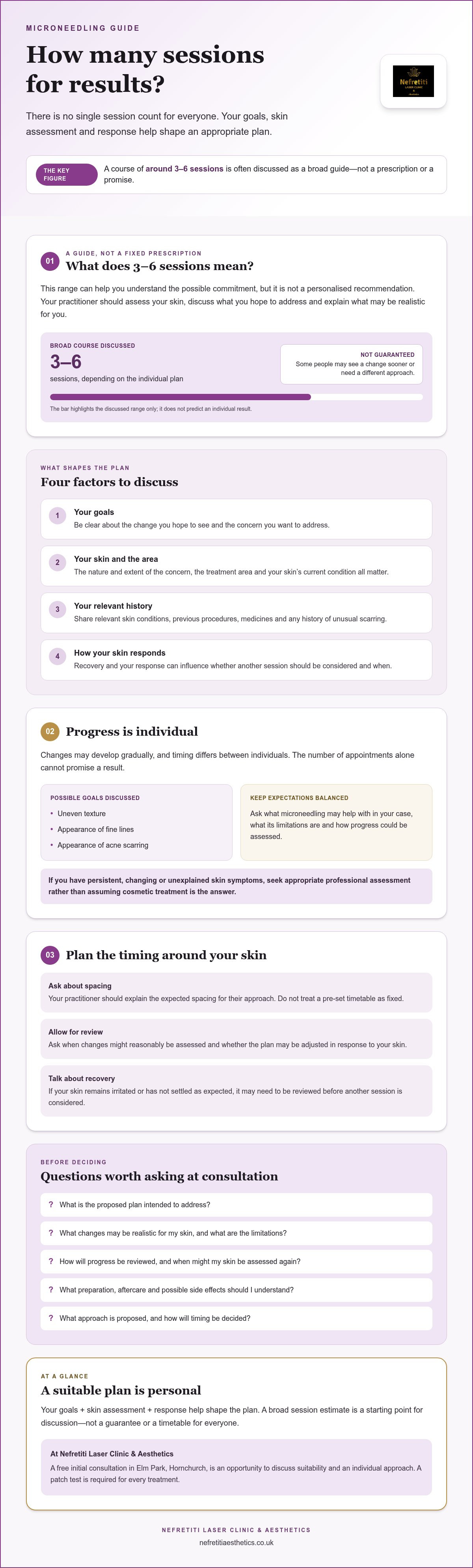
A course of three to six sessions is often discussed for a range of skin concerns, but it’s a guide, not a promise or a plan that fits everyone. Changes can develop gradually, and the time between appointments matters too. Your practitioner should explain what may be realistic for you, how much recovery time to allow and when your skin can be assessed again.
This article explores why session plans vary, what can influence visible changes and which questions to ask before deciding. You’ll also find guidance on consultation, preparation, aftercare and possible side effects. At Nefretiti Laser Clinic & Aesthetics in Elm Park, Hornchurch, a free initial consultation is an opportunity to discuss suitability and an individual approach. A patch test is required for every treatment.
Table of Contents
How many microneedling sessions for results? Start with the realistic answer
There isn’t one session count that suits everyone. As a broad guide, a course of around three to six sessions is often discussed for different skin concerns, but this is not a prescription or a guarantee. The right plan depends on what you hope to address, your skin’s starting point, the treatment approach and how your skin responds.
That distinction matters. A general estimate can help you understand the possible commitment, but only an individual assessment can determine whether microneedling is suitable and what schedule may be appropriate. Results vary, and some people may see a change sooner or need a different approach.
Why there is no single session count for everyone
People consider microneedling for different reasons, such as uneven texture, the appearance of fine lines or acne scarring. The nature and extent of the concern, the area being treated and the condition of your skin can all affect what a practitioner recommends. The procedure is also known as collagen induction therapy, but the name alone doesn’t tell you how many sessions you’ll need.
During an assessment, a practitioner should discuss your goals, review relevant skin and treatment history, and consider suitability. They can then explain the proposed approach and what may be realistic for your circumstances. A standard course shouldn’t be assumed to apply to every client or concern.
What a realistic answer should include
When researching how many microneedling sessions for results, treat any general range as a starting point for discussion, not a personalised recommendation. Ask what the proposed plan is intended to address, how progress will be reviewed and whether it may be adjusted in response to your skin.
Visible changes may develop gradually, and timing differs between individuals. Following consultation, your practitioner should explain the expected spacing between appointments for their approach, when changes might reasonably be assessed and what could affect progress. If the likely benefits, limitations or recovery expectations aren’t clear, ask for more explanation before deciding.
A personalised microneedling plan is based on your goals, skin assessment and response, not a promised number of appointments or a guaranteed result.
What affects how many microneedling sessions you may need?
The session plan is shaped by more than the concern you want to address. Your practitioner should consider your skin’s current condition, relevant medical and treatment history, goals, and how your skin heals after treatment. These factors help determine whether microneedling is suitable, what approach may be appropriate and whether another session should be considered.
Ask how the recommendation relates to your specific concern instead of relying on a session estimate you’ve seen online. The Cleveland Clinic’s guide to microneedling provides general patient information, but it can’t replace an individual assessment.
How your skin concern and goals shape the plan
Be specific about the change you hope to see. Someone exploring general skin rejuvenation may have different priorities from someone asking about the appearance of stretch marks. The practitioner should explain what microneedling may help with in your case, its limitations and how progress could be assessed. Results aren’t guaranteed, and treatment may not be appropriate for every concern.
If you have persistent, changing or unexplained skin symptoms, seek appropriate professional assessment rather than assuming cosmetic treatment is the answer. Share any relevant skin conditions, previous procedures, medicines or history of unusual scarring during your consultation. These details can affect suitability and the advice you receive.
How skin response and treatment approach can matter
Recovery is part of treatment planning. If your skin remains irritated or hasn’t settled as expected, a practitioner may recommend reviewing it before considering another session. Tell them how your skin responded, including any concerns, rather than treating a pre-set timetable as fixed.
Methods can differ, so don’t assume that the needle depth, device or protocol used elsewhere applies to your treatment. Ask what approach is proposed, why it fits your goals and how the practitioner will decide on timing. At Nefretitia Esthetics, a patch test is required for every treatment. Ask what this involves and how it fits into your plan.
Your microneedling plan should reflect assessed suitability, your goals and your skin’s response, not a session count intended to fit everyone. An initial consultation gives you the opportunity to discuss your questions and options with the clinic.
What results can microneedling offer, and what are its limits?
Microneedling may help improve the appearance of some skin concerns, including uneven texture, fine lines and certain types of scarring. Potential benefits depend on the concern, its extent and whether treatment is appropriate for your skin. The Cleveland Clinic’s guide to microneedling results outlines possible uses, but general information can’t predict how your skin will respond.
It’s helpful to distinguish the skin’s short-term reaction from any longer-term change. Redness, warmth, tightness or sensitivity can occur soon after treatment. These are recovery effects, not evidence that a lasting result has already been achieved. Your practitioner should explain which reactions may be expected with their approach and what to do if symptoms concern you.
When might changes become noticeable?
Any visible improvement is usually gradual rather than immediate. Some people may notice changes in texture or tone over time, while others see less change. Collagen remodelling takes time, so the appearance of the skin may continue to develop after treatment. Timing varies with the individual and treatment plan.
Ask your practitioner when it would be reasonable to review progress and how it will be assessed. Photos or testimonials can illustrate one person’s experience, but they can’t show what’s typical or guarantee a similar outcome for you. Don’t judge the result while your skin is still recovering.
What microneedling cannot promise
Microneedling can’t promise a particular change, number of sessions or timeline. It may not address every skin concern, and a cosmetic treatment isn’t a substitute for assessment of a medical or unexplained skin problem. The expected benefit should be weighed against the possibility of temporary irritation and other treatment risks discussed during consultation.
If a skin symptom is persistent, worsening, painful, bleeding or changing, seek appropriate medical advice before considering cosmetic treatment. A practitioner should review your skin and relevant history before recommending microneedling, and may advise that another form of assessment is more suitable.
For a clearer answer to how many microneedling sessions for results, focus on the outcome being considered and how progress will be reviewed, rather than expecting a guaranteed transformation. Following consultation, ask what changes may be realistic for your concern, how long assessment should take and what signs mean you should contact the practitioner or seek medical advice.
How should you plan microneedling sessions, intervals and aftercare?
Agree a clear plan before treatment begins instead of relying on a timetable found online. It should cover consultation, suitability, the proposed approach, treatment and follow-up. Your practitioner can explain what the plan is intended to address and how they’ll decide whether another session is appropriate.
There’s no universal interval for every client. Spacing should reflect the treatment approach, your skin’s recovery and the practitioner’s protocol. Ask why the proposed timing is suitable for you and whether it might change after your skin is reviewed. This helps you understand the likely commitment without treating an estimate of how many microneedling sessions for results as a fixed promise.
Questions to ask before agreeing to a course
Which concern is the proposed plan intended to address, and what change may be realistic?
How will progress be reviewed, and when will you decide whether another session is suitable?
What interval do you recommend for my skin, and what could lead you to adjust it?
What suitability factors, risks or possible side effects should I consider?
What preparation and aftercare instructions should I follow, and who should I contact if I’m concerned?
Share relevant skin history, current symptoms, medicines, skincare products and recent or planned treatments. This gives the practitioner useful context when assessing suitability and discussing the approach.
Preparation, recovery and aftercare to confirm
Follow the clinic’s treatment-specific advice rather than relying on generic online instructions. Beforehand, ask what to pause or avoid, if anything, and what to expect during recovery. After treatment, follow the aftercare guidance provided, and check before applying products or resuming activities if you’re unsure. Don’t assume recovery time or restrictions will be the same for everyone.
Temporary redness or sensitivity may occur, but your practitioner should explain which reactions are expected with the treatment and how to care for your skin. Contact the clinic if a reaction is unexpected, worsening or causing concern. Seek medical advice if symptoms are severe or you think you may need urgent care.
At Nefretitia Esthetics in Elm Park, Hornchurch, the free initial consultation is an opportunity to discuss your goals and suitability. Ask how it fits into your plan.
Arrange a microneedling consultation.
Plan microneedling results with Nefretitia Esthetics in Elm Park
Nefretitia Esthetics offers microneedling at its clinic in Elm Park, Hornchurch. A free initial consultation gives you time to talk through your goals, share relevant skin history and discuss whether treatment may be suitable. It’s an opportunity to ask questions and understand the proposed approach, not a commitment to proceed.
There isn’t a set session plan that can be recommended for everyone. If you’re asking how many microneedling sessions for results, the practitioner can discuss a plan based on your concerns, suitability and how progress will be reviewed. Ask the clinic what it involves and when it should take place.
What to discuss at a local microneedling consultation
Before your appointment, consider what you’d like to address and what would count as a meaningful, realistic change for you. Tell the practitioner about relevant skin history, current concerns, previous treatments and any products or medicines that may be important. This context helps them assess suitability and explain limitations as well as potential benefits.
Useful questions include:
What treatment approach may be appropriate for my concern?
What interval would you recommend between sessions, and could it change?
What side effects and recovery should I plan for?
What preparation and aftercare instructions should I follow?
How will we review progress and decide whether another session is suitable?
You can also explore the clinic’s guide to aesthetic treatments before your consultation. The Elm Park clinic is relevant for people travelling from nearby Essex communities, including Romford, Upminster, Rainham, Dagenham, Gidea Park, Harold Wood and Harold Hill.
Choose your next step with confidence
A good consultation should leave you with a clear understanding of the proposed plan, possible risks, aftercare and what results may be realistic. Take time to consider the information and ask for clarification if anything is unclear. The aim is an informed decision that feels right for you, without pressure or promises about a particular outcome.
Arrange your free initial consultation.
Take the next step towards a personalised microneedling plan
There’s no universal answer to how many microneedling sessions for results. Your goals, skin assessment, treatment approach and individual response all influence the plan, and visible changes aren’t guaranteed. A consultation should help you understand suitability, realistic expectations, session spacing, recovery and aftercare before you decide.
Nefretitia Esthetics offers a free initial consultation at its Elm Park, Hornchurch clinic. It’s a chance to discuss your questions and explore a suitable approach without pressure. The clinic is accessible to people from nearby Essex communities, including Romford, Upminster and Rainham.
With clear advice and a plan shaped around your skin, you can make an informed decision at your own pace.
Frequently Asked Questions
How many microneedling sessions are usually needed for results?
There’s no standard number that guarantees results for everyone. A course of three to six sessions is sometimes used as a broad guide, but your needs may differ according to your skin concern, its extent, the treatment approach and your response. Treat online estimates as a starting point for questions, not a personalised prescription. A practitioner should assess your skin and explain a suitable plan and its limitations.
How far apart should microneedling sessions be?
Your practitioner should set session spacing rather than relying on a universal timetable. The appropriate interval can depend on the treatment approach, your skin’s recovery and the concern being addressed. Ask why the recommended timing suits your circumstances and whether it might change after a review. Don’t book another session until your skin has settled as advised and any unexpected reaction has been discussed.
Can you see results after one microneedling session?
Some people may notice a temporary glow or smoother-feeling skin after one treatment, but this doesn’t mean a lasting change is assured. Microneedling-related changes can develop gradually, and one session may not achieve the result you have in mind. Following consultation, your practitioner can explain what may be realistic for your concern and when it makes sense to assess progress.
How long does it take to see results from microneedling?
Visible changes may take time and vary between individuals. Redness, warmth or sensitivity immediately after treatment are short-term skin reactions, not the same as longer-term improvement. Timing can depend on your skin, the concern being treated and the treatment approach. Ask your practitioner when progress should be reviewed, and avoid judging the outcome before your skin has recovered as instructed.
Is microneedling suitable for every skin type?
No, microneedling isn’t automatically suitable for every person or skin concern. Suitability depends on an individual assessment, including your current skin condition, relevant history and any medicines or previous treatments. Tell the practitioner about active or unexplained symptoms and any history of unusual scarring. They can discuss possible risks and whether treatment is appropriate or another professional assessment should come first.
What should I expect after a microneedling session?
Temporary redness, warmth, sensitivity, mild swelling, dryness or light flaking may occur, though experiences differ. Your practitioner should explain which reactions may be expected with their treatment method and give you specific aftercare instructions. Follow that advice rather than generic online guidance. Contact the practitioner about a reaction that is unexpected, worsening or concerning. Seek medical advice if symptoms are severe or you need urgent care.
How do I know whether microneedling is right for my skin concern?
A professional consultation is the best way to discuss whether microneedling may suit your goals. Explain what you hope to address and share your skin history and any previous treatments. Ask about likely benefits, limitations, risks and how progress will be reviewed. Nefretitia Esthetics offers microneedling and a free initial consultation in Elm Park, Hornchurch, with a patch test required for every treatment.
Ready to discuss your goals and suitability? Book a free initial consultation with Nefretitia Esthetics in Elm Park, Hornchurch.


Comments