


How to Boost Collagen in Your Face Over 50: A Realistic Guide
Ageing skin can’t be turned back, but you can still support its health and appearance after 50. If you’re wondering how to boost collagen in face over 50, start by separating realistic options from claims that promise too much. Changes in firmness and texture are common, and they don’t mean you need an invasive procedure.
You may be weighing up skincare, diet, supplements or professional treatments. Conflicting advice can make it hard to know where to begin. This guide explains how collagen contributes to visible skin changes, which everyday habits may support skin health, and why sun protection and consistent care matter. It also covers what collagen-conscious treatments may offer, their limitations and why suitability should be assessed before treatment.
At Nefretiti Laser Clinic & Aesthetics in Elm Park, Hornchurch, options including microneedling, chemical peels, skin boosters, Profhilo and polynucleotides can be discussed following consultation. Results vary, and no treatment can promise to restore skin to an earlier age. The aim is to help you make an informed choice about what may suit your skin and expectations.
Table of Contents
Why facial collagen changes after 50, and what that means for your skin
Changes in firmness, texture and fine lines can become more noticeable with age. They are a normal part of having skin, not a sign that anything is wrong or that you need treatment. If you’re considering how to boost collagen in face over 50, it helps to understand what collagen does and what else can influence your skin.
Collagen is a structural protein found in the skin and other parts of the body. In skin, its fibres help form a supportive framework and contribute to firmness and strength. The overview of collagen explains its structure and biological functions. Collagen provides support, while hydration relates to the skin’s water content. Dryness or dullness can have causes other than changes in collagen.
What does collagen do in facial skin?
Think of collagen as part of the skin’s internal support structure. Changes to that structure may contribute to a less firm appearance, while fine lines and uneven texture can have several contributing factors. People experience these changes differently. Skin type, inherited characteristics, health, lifestyle and past sun exposure can all play a part, so one person’s experience is not a reliable prediction of another’s.
Why can skin look different after 50?
Ageing involves gradual changes in skin structure and function. Hormonal changes, including those associated with menopause, may also affect how skin feels and looks, although the effects vary. Environmental exposure matters too. Sun exposure can damage skin over time, and smoking can affect skin health. These are influences, not reasons to blame yourself. Past exposure and individual circumstances are not always within your control.
Collagen is only one part of facial appearance. Hydration, pigmentation, facial movement, genetics and general health can also influence what you see. That is why a single ingredient or procedure cannot address every concern, and why claims that one approach will restore everyone’s skin should be treated cautiously.
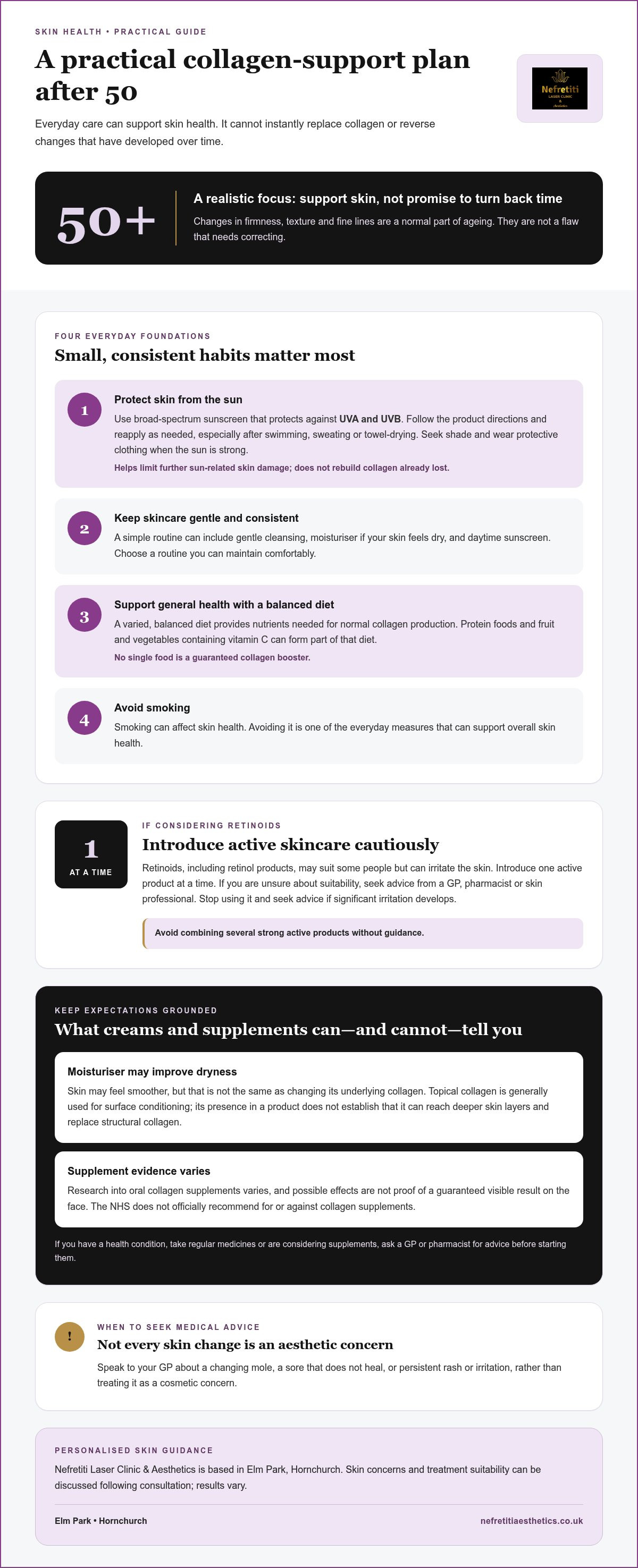
Gradual changes in firmness or fine lines are different from a new or persistent symptom. If you notice a changing mole, a sore that does not heal, or a persistent rash or irritation, seek advice from your GP rather than treating it as an aesthetic concern. An appropriate assessment can help distinguish changes that may be suitable for cosmetic care from symptoms that need medical attention.
What may support collagen naturally after 50?
Everyday care can support skin health, but it cannot instantly replace collagen or reverse changes that have developed over time. A practical approach is to protect your skin from further sun damage, keep your routine comfortable and consistent, and support your general health without expecting any single food or product to transform your face.
Which daily habits are worth prioritising?
Make sun protection part of your regular routine, not just something you use on holiday. Choose a broad-spectrum sunscreen that protects against UVA and UVB, follow the product directions and reapply as needed, especially after swimming, sweating or towel-drying. The NHS also advises seeking shade and wearing protective clothing when the sun is strong. These measures help limit further sun-related skin damage; they do not rebuild collagen already lost.
A realistic everyday approach is regular sun protection, gentle and consistent skincare, a balanced diet with adequate protein, and avoiding smoking. The NHS advises that a varied, balanced diet provides nutrients needed for normal collagen production. Protein foods and fruit and vegetables containing vitamin C can be part of that diet, but no single food is a guaranteed collagen booster.
Keep your skincare routine simple enough to maintain. Cleanse gently, moisturise if your skin feels dry, and use sunscreen during the day. Retinoids, including retinol products, may suit some people, but can irritate the skin. Introduce an active product cautiously, one at a time, and seek advice from a GP, pharmacist or skin professional if you are unsure about suitability. Stop using it and seek advice if significant irritation develops. Avoid combining several strong active products without guidance.
Do collagen creams or supplements rebuild facial collagen?
Be cautious about claims that a cream or supplement will directly rebuild the skin’s deeper support structure. A moisturiser can improve dryness and make skin feel smoother, but this is not the same as changing its underlying collagen. Topical collagen is generally used for surface conditioning. Its presence in a product does not establish that it can reach deeper skin layers and replace structural collagen.
Research into oral collagen supplements varies, and evidence about possible effects should not be treated as proof of a guaranteed visible result on the face. The discussion of Collagen Supplements and Skin Health provides context on the limits of these claims. The NHS does not officially recommend for or against collagen supplements. A balanced diet remains a sensible foundation for general health.
If you have a health condition, take regular medicines or are considering supplements, ask a GP or pharmacist for advice before starting them. For personalised guidance on your skin concerns and care options, you can book an initial consultation with Nefretiti Laser Clinic & Aesthetics.
Can professional facial treatments boost collagen after 50? Benefits and limits
No facial treatment can stop ageing or promise the same result for everyone. Some treatments may support skin rejuvenation or address a particular concern, but the right option depends on your skin, health, expectations and tolerance for recovery. If you’re exploring how to boost collagen in face over 50, focus on the treatment’s purpose and limitations, not just its marketing language.
Different treatments are designed for different concerns. The comparison below is a starting point, not a recommendation. Suitability, response, downtime and risks vary. NHS guidance on cosmetic procedures also encourages people to consider potential risks and recovery before proceeding.
How do microneedling and peels differ?
Microneedling uses fine needles to create controlled punctures in the skin. A chemical peel uses a solution to exfoliate the skin to a chosen depth. Their purpose, depth and recovery can differ, so neither is automatically suitable for every skin type or concern. Nefretiti Laser Clinic & Aesthetics offers microneedling, chemical peels and BioRePeel. The suitability and likely effects of each option need to be considered individually; a particular collagen outcome cannot be promised.
Microneedling: May be considered for concerns such as uneven texture or the appearance of fine lines. Temporary redness, tenderness or irritation may occur. Skin condition and health history affect suitability.
Chemical peels: May be selected to address surface texture or uneven tone. The peel’s strength and your skin influence recovery and the possibility of irritation or pigmentation changes.
Skin boosters, Profhilo and polynucleotides: These injectable skin-rejuvenation options have different formulations and purposes. They may be discussed for skin quality or hydration concerns, but evidence and expected effects vary. They are not interchangeable or guaranteed collagen solutions.
Where may skin boosters and light-based treatments fit?
IPL is generally considered for selected concerns such as visible redness or pigmentation following assessment. A carbon facial may be chosen to refresh the appearance of facial skin. Neither should be presented as a proven way to rebuild facial collagen without reliable evidence for the specific device, protocol and concern. Ask what the treatment is intended to address and what a realistic response may look like.
Before a procedure, a consultation should review your medical history, current skin condition, medicines, expectations and possible side effects. Active skin problems or certain health factors may mean that treatment should be postponed or another approach considered. Depending on the treatment, recovery may involve temporary redness, sensitivity, peeling or bruising. Follow the aftercare advice given for your treatment and allow time to assess any changes. Responses can be gradual and vary between people.
Nefretiti Laser Clinic & Aesthetics offers skin and aesthetic treatments in Elm Park, Hornchurch. A personalised discussion can help you weigh up the options and decide whether a treatment may suit your goals.
How to build a safe, realistic collagen-support plan
A useful plan starts with the concern you want to address, not a promise to reverse ageing. These steps can help you decide whether everyday care is enough or whether an assessment may be helpful. Treatment choice, suitability and results vary from person to person.
Define what you’d like to improve. Be specific. Your main concern might be uneven texture, dryness or a change in firmness. Decide what a worthwhile, natural-looking improvement would mean to you, and what you do not expect a treatment to change.
Review your current skincare. Make a note of the products you use, how often you use them and whether they cause irritation. A straightforward routine is easier to assess than several new active products introduced at once.
Consider your health and skin history. Record relevant conditions, allergies, medicines and previous skin procedures. Mention any current irritation, sensitivity or unusual changes, as these may affect suitability or mean treatment should be delayed.
Discuss appropriate options with a practitioner. Ask what a proposed procedure is intended to address, what side effects may occur, what recovery may involve and what outcome is realistic. Any recommended plan and treatment intervals should be individualised rather than assumed from a general online schedule.
What should you discuss before choosing a treatment?
Bring your goals and questions to the consultation, along with details of previous procedures, regular medicines and relevant skin history. An assessment allows the practitioner to consider your skin condition and any contraindications before discussing options. It should also clarify limitations: a treatment may be unsuitable, need to wait or not be the best match for your concern.
You should have time to understand the expected benefits, uncertainties and possible adverse effects before deciding. For anyone researching how to boost collagen in face over 50, a sensible plan sets expectations carefully and does not rely on a fixed number of sessions or a standard interval for everyone.
How can you care for skin after a procedure?
Aftercare depends on the procedure and your individual response. Follow the instructions provided for your treatment, including guidance on cleansing, active skincare, exercise or makeup where relevant. Use gentle care and sun protection where advised. Do not add products or resume active ingredients until your practitioner’s instructions allow it.
Some temporary sensitivity or visible changes may be expected after certain procedures. Seek advice from your practitioner or an appropriate health professional if a reaction is severe, worsening, unusual or persistent. New or ongoing skin symptoms may need assessment by a GP rather than aesthetic treatment.
Explore collagen-conscious skin rejuvenation at Nefretiti in Hornchurch
After considering everyday skincare and the limits of treatment claims, you may want a personalised conversation about your options. Nefretiti Laser Clinic & Aesthetics is based in Elm Park, Hornchurch, and offers skin rejuvenation treatments including microneedling, chemical peels, BioRePeel, skin boosters, Profhilo and polynucleotides. These approaches differ, and any potential benefit depends on your skin, concerns and suitability. No option can guarantee a particular collagen response.
What happens at an initial skin consultation?
The free initial consultation is an opportunity to discuss what you’ve noticed, what you’d like to address and what a realistic outcome would mean to you. Your skin history, current concerns, previous procedures and relevant health information can inform the conversation. You can ask about the purpose of a suggested treatment, its potential benefits and limitations, possible risks, preparation and aftercare.
Recommendations follow individual assessment, not age alone. Suitability matters, and a treatment may not be appropriate for every person or skin concern. Nefretiti Laser Clinic & Aesthetics also requires a patch test for every treatment. The consultation gives you time to understand the process and ask questions before deciding whether to proceed. It does not commit you to treatment or guarantee a result.
How to take the next step in Elm Park
If you’re comparing options, bring a short list of questions. Ask what the treatment is intended to improve, what changes might reasonably be expected, whether there are relevant risks for your skin and what aftercare you’ll need to follow. You can also discuss whether a gradual approach or continuing with home care better fits your priorities.
The clinic welcomes clients from Elm Park, Hornchurch, Romford, Upminster, Rainham, Dagenham, Gidea Park, Harold Wood and Harold Hill, as well as Brentwood and other parts of Essex and East London. Its skin and aesthetic treatments can be discussed in the context of your individual goals. If you’re still asking how to boost collagen in face over 50, an assessment can help you distinguish suitable possibilities from claims that promise too much.
There’s no need to decide on a procedure before your questions have been answered. Book an assessment to discuss your skin concerns and whether an option may be suitable for you.
Take your next step with confidence
Deciding how to boost collagen in face over 50 does not mean pursuing every new product or procedure. Start by identifying the skin concern that matters most to you, then decide whether tailored advice would help before you make changes. Take your time, ask questions and choose an approach that feels comfortable, including choosing no treatment.
If you’d value a personal discussion, Nefretiti Laser Clinic & Aesthetics can help you explore your goals and understand which options may suit your skin. Recommendations are individual and results vary. A consultation is a chance to make an informed decision without pressure or promises.
For tailored advice, book a consultation with Nefretiti Laser Clinic & Aesthetics in Elm Park, Hornchurch, and discuss which approach may be right for you.
Frequently Asked Questions
Can you increase collagen in your face after 50?
You can support skin health, but you cannot reliably restore facial collagen to an earlier level. If you’re considering how to boost collagen in face over 50, focus on practical steps and treat professional procedures as options with limitations, not guarantees. Skin may look or feel different after consistent care, but changes depend on individual factors. A consultation can help clarify whether a treatment is appropriate for your concern.
How long does it take to see a change from collagen-focused skincare?
There is no single timeline, and some products mainly improve surface dryness or smoothness rather than deeper skin structure. Give a new routine time to show whether it suits your skin, but introduce active ingredients gradually so you can spot irritation. If you want to compare changes, take a photo in similar lighting. If your skin becomes persistently sore, swollen or uncomfortable, stop the product and seek advice.
Does eating collagen or taking collagen supplements improve facial skin?
Evidence for visible facial benefits from collagen supplements is not conclusive, and results cannot be guaranteed. The NHS does not officially recommend for or against collagen supplements. A varied diet that includes protein and vitamin C supports normal nutritional needs, but no particular food can promise a change in facial skin. If you take regular medicines, have a health condition or are pregnant, ask a GP or pharmacist before using a supplement.
Can menopause affect collagen and facial skin?
Hormonal changes during menopause may influence skin, including its texture, dryness or appearance, but experiences differ. Menopause is not the only possible explanation for a change, so consider other factors such as skincare, sun exposure and general health too. If symptoms are uncomfortable or affecting your wellbeing, a GP can discuss appropriate support. For a new or persistent skin concern, seek an assessment rather than assuming it is caused by menopause.
Is microneedling suitable for mature skin?
Age alone does not determine suitability. A practitioner should assess your skin condition, medical history, medicines and goals before discussing microneedling. It may not be appropriate if your skin is currently irritated or has another issue that could affect healing. Possible effects can include temporary redness, sensitivity or bruising, and less common complications are also possible. Ask about expected recovery and aftercare, and only proceed if you feel comfortable with the information provided.
What should I avoid after a collagen-focused facial treatment?
Follow the instructions given for the exact procedure, as aftercare differs between microneedling, peels and injectable treatments. Do not assume your usual retinoid, exfoliant, makeup or exercise routine can resume straight away. Ask your practitioner when to restart active skincare and what to do about sun exposure. Avoid picking or rubbing treated skin. If you were not given clear instructions, contact the treating practitioner before applying strong products or trying another treatment.
When should I seek professional advice about a change in my skin?
Contact your GP about a changing mole, a sore that does not heal, or a new, persistent or worsening rash. These changes need appropriate health assessment rather than cosmetic treatment. After a procedure, seek prompt advice if you develop severe pain, spreading redness, increasing swelling, discharge or a reaction that concerns you. If you’re in Elm Park, Hornchurch, Romford, Upminster, Rainham, Dagenham, Gidea Park, Harold Wood or Harold Hill, you can also discuss aesthetic concerns with Nefretiti Laser Clinic & Aesthetics, subject to assessment.


Comments