


How Often Should You Get a HydraFacial? A Personalised Guide
Could a monthly HydraFacial be more than your skin needs, or not often enough for your goals? If conflicting advice has left you wondering how often should you get a HydraFacial, you’re not alone. A familiar interval can be a starting point, but it isn’t a rule for everyone.
Your skin’s needs, your response to treatment and what you hope to address all matter when planning appointments. Some people may prefer regular treatments, while others may choose them less often. Having treatments too frequently may not be suitable for you, so plan around your skin rather than following a calendar automatically.
This guide explains what can influence treatment frequency, what to discuss with a practitioner and how to approach your schedule thoughtfully. At Nefretiti Laser Clinic & Aesthetics in Elm Park, Hornchurch, new clients can have a free consultation and patch test to discuss their skin goals and suitability before planning treatment.
Table of Contents
How often should you get a HydraFacial? The short answer
There isn’t one HydraFacial interval that’s right for everyone. If you’re wondering how often should you get a HydraFacial, the most useful answer is that your schedule should reflect your goals, current concerns and response to treatment, rather than follow a fixed calendar.
An interval suggested online is an example, not a personal recommendation. It may not account for your skin’s current condition, previous treatment experience or how your skin responds afterwards. A practitioner can consider those details with you and discuss whether another appointment is appropriate or whether it would be better to wait and reassess.
Why there is no universal HydraFacial schedule
Frequency can depend on what you hope to address, what your skin is experiencing now and how it has responded to previous treatments. Someone seeking general skin maintenance may have different priorities from someone concerned about congestion or dryness. An assessment helps put those goals in context instead of assuming the same interval suits everyone.
Online advice can help you understand the range of suggested approaches, but it can’t assess your individual skin. Treat schedules you read as general guidance. They don’t promise a particular result and shouldn’t replace a professional recommendation based on your circumstances.
What a HydraFacial treatment plan is designed to do
A treatment plan gives you and your practitioner a shared, realistic approach to your skin goals. It can set out a starting point, consider whether the treatment is suitable and leave room to review your response before planning further appointments. It doesn’t have to commit you to a set course. You can reconsider the plan as your needs or preferences change.
The treatment approach and details can be discussed following assessment. You can explore HydraFacial treatment details before your appointment, then use your consultation to talk through how the service relates to your goals. Results vary, so a schedule should support informed decisions, not promise a particular outcome.
Before agreeing a plan, consider:
Your priority: Be clear about the skin concern or appearance you’d like to focus on.
Your starting point: Share relevant changes in your skin and any previous treatment experience.
Your response: Review how your skin feels and looks after an appointment before discussing what comes next.
Your routine: Choose a plan that feels manageable, and follow your practitioner’s advice on preparation and aftercare.
At Nefretiti Laser Clinic & Aesthetics in Elm Park, Hornchurch, a consultation gives you the opportunity to discuss your goals and a suitable schedule. The aim is a considered, personalised plan, not a one-size-fits-all timetable.
What affects how often you should have a HydraFacial?
For a useful treatment discussion, bring more than a skin-type label. Explain what you want to focus on, what you’ve already tried and what would make an appointment worthwhile. This gives the practitioner context behind your request, rather than relying on a broad description such as “oily” or “sensitive”.
Skin goals and current concerns
Think about whether your aim is general skin maintenance or whether a particular change is bothering you. You might want to discuss how your skin looks or feels, or mention a persistent concern you’re unsure how to address. Be specific about what you’ve noticed and how long it has been on your mind, without trying to diagnose it yourself.
Share relevant history and the products you currently use, especially if your routine has changed. A practitioner can assess whether HydraFacial is appropriate for your concern and explain its limitations. If a concern seems to need medical attention, seek suitable professional advice rather than assuming a facial will address it. Everyday skincare also matters. The Mayo Clinic’s tips for healthy skin offer broader guidance beyond appointments.
Expectations matter, too. Decide what you would count as a worthwhile change, then ask what the treatment may realistically help with. This can clarify whether the suggested approach matches your priorities and give you a clearer way to review your experience afterwards.
Treatment response and personal circumstances
After an appointment, make a brief note of your experience while it’s fresh. Record how your skin felt, whether you noticed anything unexpected and what you’d like to discuss next time. These details are more useful than relying on memory alone. If an unexpected concern arises, contact your practitioner for advice rather than making assumptions about another treatment.
Your practical circumstances also shape a workable plan. Consider how appointments fit around your routine, budget and other skincare commitments. If you can attend less often than a suggested schedule, say so openly. A plan only makes sense if it reflects both your priorities and what you can realistically maintain.
Use the consultation to ask how your practitioner will review your experience and what might lead them to adjust their advice. You can also discuss whether another skin treatment may be relevant to your concern. Nefretiti Laser Clinic & Aesthetics offers HydraFacial in Elm Park, Hornchurch, where a personalised discussion can help you make an informed decision about the next step.
Monthly, fortnightly, or less often: how to assess HydraFacial advice
Published advice includes several approaches, from an appointment every four weeks to a proposed course with fortnightly visits. The table compares these examples and their sources. Use it to understand what a suggested schedule refers to, then discuss whether it fits your circumstances.
How to interpret different suggested intervals
The examples differ in both spacing and purpose. Some describe recurring appointments, while others outline a short initial series. Clarify the distinction: a proposed course isn’t the same as an ongoing maintenance plan. The source’s wording matters, too. A general example or a suggestion linked to a particular concern may not reflect an assessment of your individual skin.
When to review a suggested schedule
Before agreeing to an interval, ask what it is intended to achieve, what information informed it and when it will be reviewed. Ask how the plan might change if your skin responds differently than expected. These questions help you understand the reasoning and make an informed choice. Raise skin or safety concerns with your practitioner before planning another appointment.
At Nefretiti Laser Clinic & Aesthetics in Elm Park, Hornchurch, you can discuss the reasoning behind suggested timing as part of a personalised HydraFacial consultation.
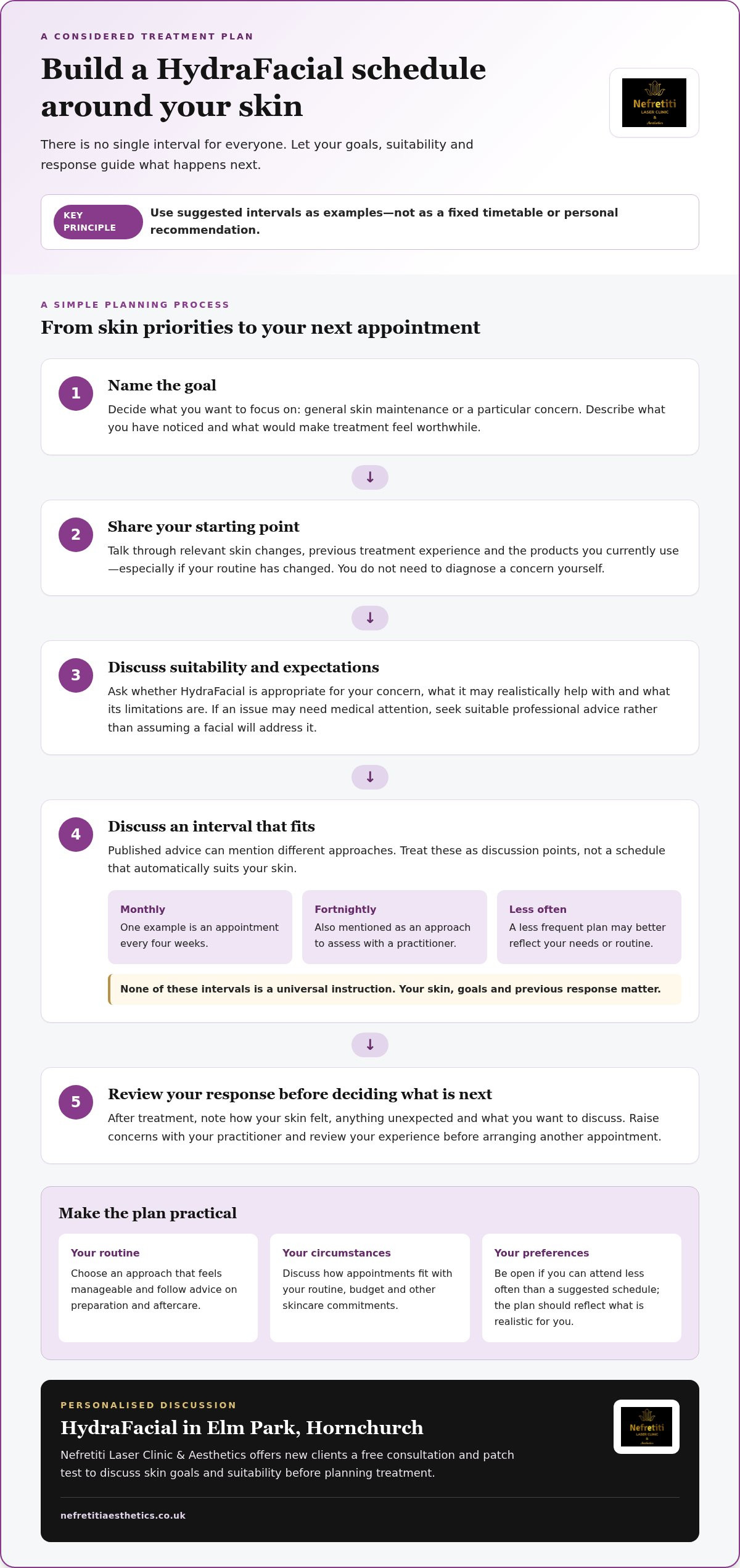
How to plan HydraFacial appointments around your skin and routine
A practical plan involves more than choosing a date. Discuss suitability and preparation first, then use your experience after treatment to inform any later appointments. This gives you a clear process without assuming every visit will feel the same.
Identify your goals. Describe what you hope to address and what a worthwhile outcome would mean to you. Be realistic: results vary, and treatment isn’t a guaranteed solution to a skin concern.
Discuss suitability and preparation. Tell your practitioner about relevant skin concerns, previous treatments and the skincare products you use. Ask whether anything in your routine should be adjusted before treatment, then follow the specific advice you’re given.
Attend with realistic expectations. Make sure you understand the planned approach and have had a chance to raise questions. Mention any current skin changes and discuss new products before using them in the lead-up to treatment.
Follow your aftercare advice. Protect your skin from direct sun and use a broad-spectrum SPF of at least 30. Your practitioner may also advise avoiding heat, strenuous exercise, swimming and exfoliating products, acids or retinoids for a period after treatment. Follow the instructions you receive for your individual circumstances.
Review before planning again. Note how your skin feels and looks, including anything unexpected, and discuss this with your practitioner before deciding on another appointment.
Questions to discuss before setting appointment frequency
Ask what preparation is appropriate for your skin and whether your current products or other treatments could affect the plan. Mention active skin problems such as a cold sore, infection, open area or sunburn, as well as any flare-up of a condition such as rosacea or eczema. These may affect suitability. Also disclose pregnancy or recent isotretinoin use so the practitioner can assess your circumstances and advise you.
After treatment, mild temporary redness, warmth, itching, swelling or flaking can occur. Follow the aftercare instructions you receive, and avoid adding exfoliating acids or retinoids until your practitioner advises they’re suitable again. If you’re unsure whether a symptom is expected, contact the clinic for advice rather than trying to manage it by changing products or booking another treatment.
Reviewing your response between treatments
Keep a simple note of how your skin responds and any questions that arise. If you notice a reaction that concerns you, or symptoms that are severe or getting worse, seek professional advice promptly. Don’t proceed with another appointment until your skin concerns have been assessed and you’ve received guidance on what to do next.
A careful conversation before and after treatment can help you make decisions with greater confidence. At Nefretiti Laser Clinic & Aesthetics in Elm Park, Hornchurch, you can discuss your goals, suitability and preparation with your practitioner.
Personalised HydraFacial advice at Nefretiti Laser Clinic & Aesthetics
You don’t need to settle on a schedule before discussing what you want from treatment. Nefretiti Laser Clinic & Aesthetics offers HydraFacial in Elm Park, Hornchurch. Frequency advice can take account of your goals, skin and suitability. A consultation can turn general online suggestions into a discussion about what may be appropriate for you.
What to expect from a personalised consultation
New clients can have a free consultation and patch test. In the clinic’s private treatment environment, you can talk through your priorities, ask questions and explain any concerns that may affect suitability. The discussion can cover what you hope to achieve and what a realistic approach might look like, without assuming you need monthly appointments or a set course.
It may help to think about your questions beforehand. Explain whether your aim is general skin maintenance or to focus on a particular concern. Share relevant treatment history and describe the skincare products you currently use. This gives the practitioner useful context to assess your needs and discuss a suitable schedule with you.
Frequency is only one part of the conversation. Ask what a proposed interval is based on, how your response might inform future appointments and whether the plan can be reviewed. The aim is to make a considered decision together, rather than feeling you must follow a timetable simply because it is common advice elsewhere. Results and individual needs vary.
The clinic is based in Elm Park, Hornchurch, and welcomes clients from nearby Romford and Upminster, as well as Rainham, Gidea Park and across Essex. Whether you’re new to HydraFacial or revisiting a treatment you’ve had before, bring your questions and describe your priorities openly. A professional assessment can help you understand suitability and discuss a schedule that feels realistic for your skin and routine.
Book a HydraFacial consultation in Elm Park
When you feel ready, book a consultation to discuss HydraFacial at Nefretiti Laser Clinic & Aesthetics. There’s no one-size-fits-all answer to how often should you get a HydraFacial. An individual conversation is a reassuring place to start, so you can explore your goals and receive guidance following assessment without assuming a particular frequency or outcome.
Take the next step towards a HydraFacial plan that feels right for you
You don’t need to arrive with a treatment calendar already decided. If you’re still asking how often should you get a HydraFacial, use that uncertainty as a starting point for a conversation about your priorities, expectations and what feels manageable. A thoughtful discussion can help you make an informed choice without feeling pressured to commit to a particular routine.
Before booking, consider writing down the main questions you’d like answered. You might want to talk about your skin goals, what to expect from an individual assessment or how to review your plan over time. Bringing those questions can make it easier to focus on what matters to you.
Nefretiti Laser Clinic & Aesthetics welcomes you to discuss HydraFacial in a calm, supportive setting. Take the next step when you feel ready.
A personalised conversation can help you move forward with greater confidence and a plan shaped around you.
Frequently Asked Questions
How often should you get a HydraFacial for acne-prone skin?
There isn’t a set interval based on acne-prone skin alone. If you’re asking how often should you get a HydraFacial, discuss your concerns, skincare routine and previous treatment experience with a qualified practitioner. Online recommendations differ, so treat them as examples rather than universal guidance. An assessment can help establish whether the treatment is suitable and whether repeat appointments fit your goals.
Is a HydraFacial every month necessary?
No, a monthly HydraFacial isn’t necessary for everyone. Some clinics suggest monthly appointments, but that doesn’t make them a requirement or mean your skin will suffer if you miss one. Your decision should take account of your aims, suitability and experience after treatment. If you’re unsure whether to rebook, discuss what you hope to maintain and whether another appointment makes sense for you.
Can you have a HydraFacial every two weeks?
Fortnightly appointments appear in some clinics’ proposed treatment courses, but that schedule shouldn’t be assumed to suit every client. Before agreeing to it, ask your practitioner why that timing is being suggested and how your individual circumstances have been considered. More appointments don’t guarantee better results. If you’re uncertain, discuss the plan and your expectations before committing to repeat visits.
How long do HydraFacial results last?
There isn’t a guaranteed duration that applies to everyone. People may experience or perceive changes differently, so avoid relying on a fixed timeframe when planning maintenance or a special occasion. At consultation, describe what you hope to see and ask how results may vary in your circumstances. Your practitioner can discuss realistic expectations and whether further appointments fit your goals, without promising a particular result or duration.
Should you get a HydraFacial before a special event?
Discuss your event date and desired outcome during consultation rather than relying on a universal timing rule. Your practitioner can consider your suitability, previous treatment experience and the event you’re planning for, then advise whether an appointment fits your circumstances. Allow time to follow the preparation and aftercare guidance you’re given. Responses vary, so don’t assume treatment will create a specific appearance by a particular date.
Is HydraFacial suitable for sensitive skin?
Sensitive skin doesn’t automatically determine whether HydraFacial is suitable. Describe what sensitivity means for you, including current concerns, skincare products or past reactions, so the practitioner can assess your circumstances. Don’t assume advice written for someone else applies to your skin. Follow the professional guidance provided following assessment, and raise any concerns before treatment so suitability can be considered carefully.


Comments